
Lincoln County Projected and Actual Release
A projected date is forward-looking. It reflects the sentence data, credits, eligibility rules, and holds known to the custodian at that point. An actual release date records that a person left a specific custody. The Lincoln County sheriff release feed uses “Release Date” for a completed exit from the county detention center. MDOC uses the precise public label “Tentative Release Date.” A court's final disposition date marks a case event, not the moment a person walked out.
Pretrial detainees usually have no sentence-based release date. Their next event can depend on bond, a court order, dismissal, plea, or trial. A person serving a county-only sentence may have a term and jail-time credit, but no official Lincoln County good-time policy was found. State prison calculations belong to MDOC. Federal dates belong to the Bureau of Prisons. Keep both the date label and its source attached to any result.
Find a Lincoln County Release Date
Start with custody type. The Lincoln County Jail cannot certify an MDOC prison calculation, and MDOC does not compute the end of every county misdemeanor booking. A name may also match more than one person. Use the booking number, MDOC ID, cause number, and date of birth when the official system permits it. The Lincoln County released-inmate record path shows how to establish the correct custodian before interpreting a future date.
- Confirm the current custodian through the county roster, MDOC record, BOP locator, or direct agency contact.
- For state custody, search the MDOC inmate search by MDOC ID or name and open the matching detail.
- Read the exact field label, including Tentative Release Date, tentative ERS date, statutory parole date, or maximum date.
- For a county sentence, request the sentencing order and credit record from the Lincoln County Circuit Clerk, plus jail release information from the sheriff.
- Ask the responsible records unit or case manager about holds, amended orders, and credit corrections before relying on the date.
- Confirm actual departure through the release sheet, discharge certificate, or other completed event record.
The official MDOC detail layout shows why labels matter. The illustrative MDOC record layout can show an image, identity details, current location, sentence data, and the Tentative Release Date field. Individual records change, so the example demonstrates the interface rather than a Lincoln County person's status.
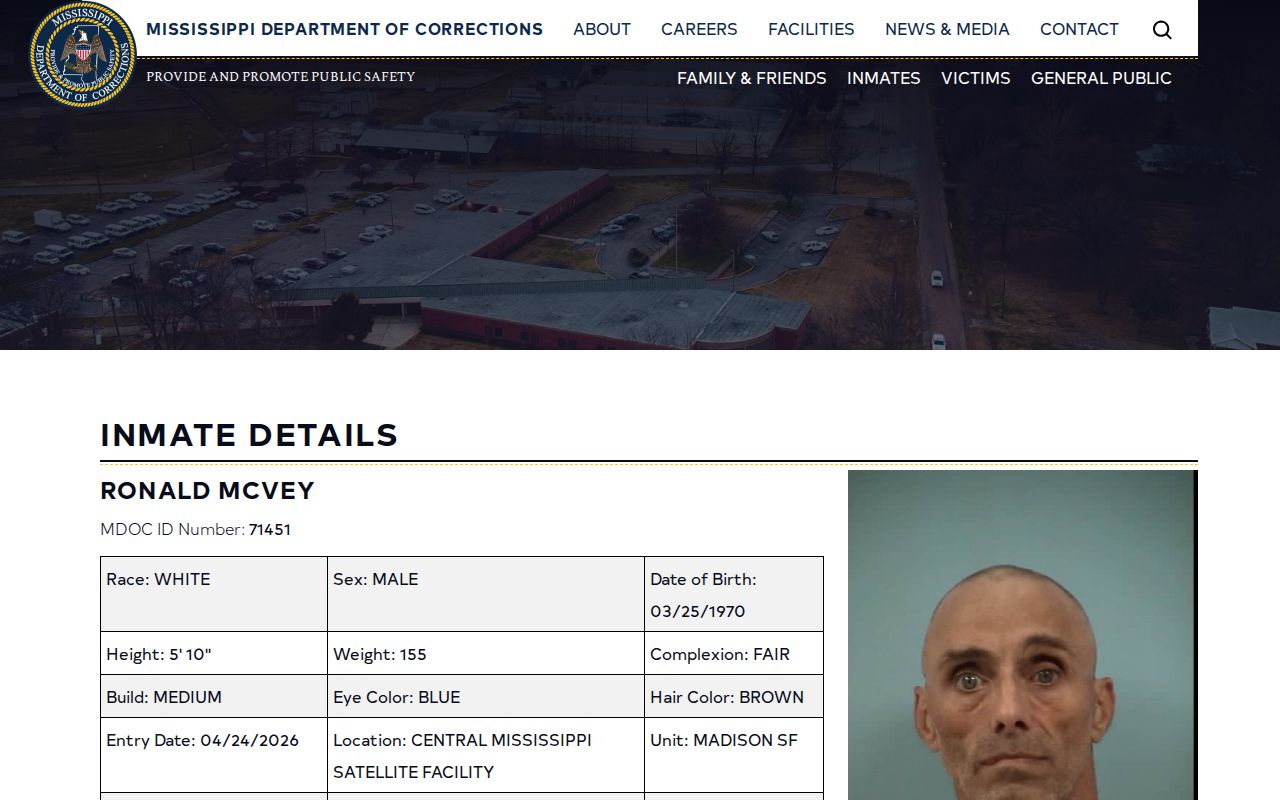
The public field is a useful starting point. The MDOC time sheet and case manager remain the individual calculation sources.
Lincoln County Release Date Labels
Mississippi sentence records can display several dates for one person. Treating them as synonyms creates false certainty. A parole eligibility date opens review. It does not show a grant. An ERS date relates to earned-release eligibility and continued MDOC jurisdiction. Tentative release is MDOC's current calculation. Maximum or discharge concerns sentence expiration. Actual release still requires processing and resolution of other lawful custody.
| Date label | What it means | What it does not prove |
|---|---|---|
| County Release Date | Recorded exit from one jail booking | Reason, destination, or end of all custody |
| Tentative Release Date | MDOC's current projected calculation | Actual departure on that day |
| Tentative ERS Date | Possible earned-release supervision point | Eligibility, approval, or full discharge |
| Statutory Parole Date | Parole consideration benchmark | A Board grant |
| Maximum or Discharge Date | Sentence-expiration benchmark | Freedom from an unrelated hold |
| Final Disposition Date | Court case event date | Physical jail-door time |
A blank public field is not a zero date. Some fields vary by record and status. Ask MDOC Records for the releasable record that carries the needed date and use the agency's own wording in notes or requests.
Note: Preserve both the date label and agency name so a later update can be compared with the same record type.
Lincoln County Earned Release Calculation
Mississippi Code section 47-5-138 supplies the post-June 30, 1995 earned-time framework. Eligible state prisoners may receive 4.5 days of earned-time allowance for each 30 days served, with a cap of 15 percent of the sentence. Subtracting that maximum creates the familiar 85-percent figure. Release under this mechanism is ERS through sentence expiration, and the person remains an inmate supervised in a manner similar to parole.
The percentage is a cap, not a personal calculator. Statutory exclusions apply. Credits may depend on conduct, classification, programs, and status. Serious violations can cause forfeiture. The MDOC handbook also discusses discretionary Meritorious Earned Time and trusty-status credits, but not all credits stack and not all prisoners qualify. Sentence date, offense type, detainers, escape history, habitual status, certain violent or sex offenses, and disciplinary action can change the result.
Pre-July 1995 sentences use older rules. Parole eligibility has its own statute and benchmarks. A county-only jail sentence cannot be assigned the state 85/15 formula merely because both take place in Mississippi. No Lincoln County jail good-time rule was found in the official material. Use the local sentencing order, jail record, and direct confirmation for that case.
Lincoln County Release Credit Records
Jail-time credit is part of the sentence start calculation. The MDOC handbook says eligible presentence or pretrial time between the offense and earliest sentence date on the current cause can be deducted to establish the sentence-begin date. MDOC requests the credit from the county of conviction. Duplicate credit is not posted. Time spent after a transfer among jails may require the incarcerated person to alert the case manager.
Consecutive terms run one after another. Concurrent terms run together, subject to the order and applicable law. Amended sentencing orders, revocations, and parole set-offs can alter the record. Ask for the time sheet when the public date does not fit the signed order. Give MDOC Records the MDOC number, county of conviction, cause number, sentence date, and exact span of jail time being questioned.
- Jail-time credit
- Eligible time in custody credited toward a sentence.
- Detainer
- A notice or request tied to another agency's custody interest.
- Set-off
- The delay until another parole hearing after a denial.
- Time sheet
- MDOC's individual sentence and credit computation record.
Why Lincoln County Release Dates Change
A projected date can move in either direction. New credit may be posted. Credit may be lost. A court can amend a sentence, and another agency can assert a hold. Parole action can change the expected route without changing the maximum sentence. Release planning can also stop a tentative ERS departure when a required residence has not been approved.
| Factor | Possible effect | Record to check |
|---|---|---|
| Earned-time award or loss | Moves an ERS calculation | MDOC time sheet and disciplinary record |
| Jail-time credit correction | Changes sentence-begin computation | County credit return and MDOC time sheet |
| Consecutive or concurrent terms | Changes total time structure | Signed sentencing orders |
| Detainer or second hold | Prevents community departure | Release destination and holding-agency record |
| Parole grant, denial, or set-off | Changes the parole path | Written Board action |
| Approved residence or planning issue | Can delay conditional release | Case manager confirmation |
Behavior, eligibility review, classification, and a discharge certificate also matter. A future date should be checked again near the expected release because the underlying record can change lawfully.
Which Lincoln County Release Date Counts?
Mississippi separates parole eligibility, ERS, tentative release or discharge, and maximum release. That distinction is the key to a Lincoln County date inquiry. An ERS projection may reflect the 15-percent earned-time cap, yet eligibility, conduct, classification, detainers, and an approved residence can still affect release. Parole adds a discretionary Board decision. Maximum release concerns sentence expiration rather than an earlier conditional status.
The safest answer names the field: “MDOC currently lists a Tentative Release Date,” not “the person will be free.” If the person left Lincoln County Jail for MDOC, the county timestamp is complete only as to that jail booking. Continue with the state record. If a detainer causes a handoff, the date can mark release from one agency while confinement continues elsewhere.
Correct a Lincoln County Release Date
MDOC says a discharge certificate is required before state release, and the case manager confirms the actual date and travel planning. That creates a concrete correction route when a public date appears wrong. MDOC Records handles offender time, jail credit, and eligibility corrections. The case manager handles the live plan. A court clerk supplies amended or signed sentencing orders.
Contact MDOC Records at P.O. Box 24388, Jackson, MS 39225, by phone at 601-933-2889, or by email at MDOCRecordsDepartment@mdoc.state.ms.us. Ask which releasable record states the date type, whether jail credit has been posted, and how to submit the court or county document supporting a correction. MDOC's published records policy lists copying at $0.15 per page plus defined actual costs and eligible labor after the first hour. Advance payment may be required.
Note: A date correction belongs with the agency that created the field, while a court-order error belongs with the issuing clerk.
Confirm Lincoln County Actual Release
Near the expected date, check the responsible custodian again. For MDOC, the case manager and discharge certificate are stronger than a saved public projection. For Lincoln County Jail, ask whether the booking number has an actual release timestamp and whether the event was community release or transfer. For federal custody, use the BOP locator and federal record.
Mississippi SAVIN can add a release or transfer notice where the reporting agency participates. Alerts can lag or fail, so they supplement rather than replace the source record. The Lincoln County VINELink inmate search covers person matching and notification steps. A final confirmation should still identify the custodian, actual event, and any destination or second hold.
MDOC says state release processing can take 30 to 45 days and requires the discharge certificate before release. That processing period is another reason not to turn a tentative field into a travel guarantee. Ask the case manager about the actual date and travel plan. If family or another support person intends to meet the individual, confirm the institution and instructions directly. Lincoln County Jail publishes no local release time of day, waiting-area rule, weekend procedure, or transport plan. Call the jail-information line before making a trip rather than importing a practice from another county.
After departure, retain the completed event record. For the county jail, preserve the booking number and Release Date. For MDOC, seek the discharge certificate or other actual release record. If a person leaves one custodian for another, record both the exit and destination. That wording recognizes the release from one agency without falsely describing a community return.